Glossary · Execution
Take profit (TP1 / TP2)
A take profit is an order that closes your trade at a set price once the market has moved your way, locking in the gain. TP1 and TP2 are two targets on one trade: TP1 at the nearest level likely to stop price, to bank part of the position early, and TP2 further out for the rest.
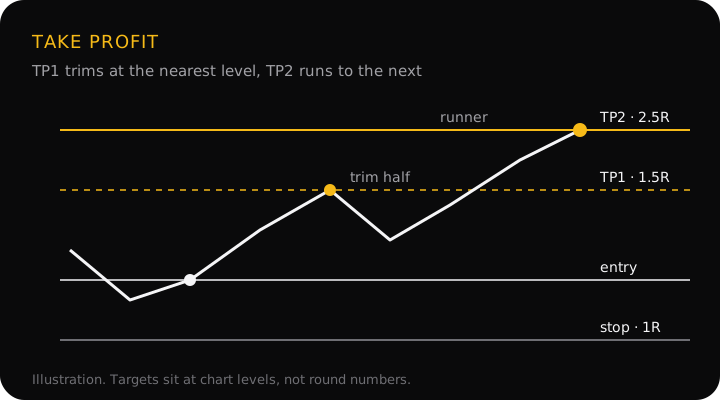
Where a take profit goes
- Find the levels in the way. For a buy, the swing highs above the entry, the buy-side liquidity resting there, and any supply zone. Each is a place where sellers have shown up before.
- Put TP1 at the nearest one, TP2 at the next. Targets go just before a level, not beyond it, because price often turns a little short of an obvious high.
- Check the ratio. Divide each target's distance by the stop loss distance. If the first real level pays less than the risk you are taking, the trade isn't worth it from this entry. The risk reward calculator does the arithmetic.
A worked example: what splitting really pays
A EUR/USD buy on a $3,000 account, risking 1% ($30). The prices are an illustration, not real data.
- The levels: entry 1.1000, stop 1.0970 (30 pips, which is 1R), TP1 1.1045 at the next swing high (45 pips, 1.5R), TP2 1.1075 at the higher one (75 pips, 2.5R).
- The size: $30 ÷ (30 pips × $10 per pip per lot) = 0.10 lots. Half (0.05 lots, $0.50 a pip) closes at TP1 and half runs to TP2.
| What happens | Result | In R |
|---|---|---|
| Stop hit before TP1 | −$30.00 | −1R |
| TP1, then the original stop | $22.50 − $15.00 = $7.50 | +0.25R |
| TP1, then a stop moved to the entry | $22.50 + $0 = $22.50 | +0.75R |
| TP1 and TP2 | $22.50 + $37.50 = $60.00 | +2R |
| One target only, at TP2, and it is hit | 75 pips × $1.00 = $75.00 | +2.5R |
Splitting turns some losers into small winners, but it takes a fifth of the profit off the trades that run all the way (2R instead of 2.5R). Neither is better in general. Which one suits you depends on how often price reaches TP1 but not TP2 on your setups, and only a journal of your own trades can answer that.
How the order fills
A take profit is normally a limit order resting at your target. The US SEC's investor education site explains that a limit order fills at the stated price or better, but only if the market reaches that price, so it is never guaranteed to fill (Investor.gov: understanding order types). It is written about shares, but forex and gold limit orders work the same way.
Two practical results. A gap through your target fills at the better price, unlike a stop. And on a sell trade the target is a buy order, which fills at the ask, so the bid price most charts show has to fall past your target by roughly the spread before it fills.
What traders disagree on
- Structure or a fixed multiple. Some set targets at chart levels; others at a fixed 2R or 3R regardless of the chart. A fixed multiple is simple to test but may sit just beyond a level price rarely passes.
- How to split. Half and half, a third at TP1, or a quarter. There is no standard; the table above shows the trade-off.
- What to do with the runner. Leave it to TP2, move the stop to the entry, or trail it behind new swings.
StraviFX uses chart levels: each target sits at a real opposing level, and neither is pushed further out just to improve the ratio.
Why it matters
The take profit is half of the risk-to-reward ratio, and the ratio decides how often you need to win. A plan without a target usually ends with a winner closed early out of nerves, or held until it turns into a loser. Deciding the exit before the entry takes that choice out of the moment.
Common mistakes
- A target beyond the level. Price often stalls just short of an obvious high. Set the target just before it.
- Stretching the target to fix the ratio. If the nearest real level doesn't pay enough, the problem is the entry or the trade, not the target.
- Moving the target further once price gets close. Greed turns a planned exit into a hope. If you want a runner, plan it as TP2 before you enter.
- Forgetting the spread on sells. A sell's target fills on the ask; leave room for it.
Questions
Should I always use two targets?
No. One target is simpler and pays the full ratio when it is hit. Two targets bank something earlier, so fewer trades that went your way end as losses, but the winners that run the whole way pay less. Pick one method and use it on every trade, so your journal can tell you which suits you.
Should I move my stop to break-even after TP1?
It is a choice, not a rule. Moving it means the rest of the trade can't lose, but normal pullbacks will close it at the entry more often. Leaving it gives the trade room but risks giving back part of TP1. Decide before you enter, then follow it.
Is a take profit guaranteed to fill?
A take profit usually works like a limit order: it fills at your price or better, but only if the market actually trades there. If price turns a pip short of it, nothing fills. On a sell trade the target is a buy order, which fills at the ask, so the chart (usually the bid) has to go past the target by about the spread.
How far should my take profit be?
Where the chart says price is likely to stall: the next opposing swing, liquidity pool or zone. Then check the ratio. If the nearest real level is too close to justify the risk, skip the trade or wait for a better entry. Don't push the target past real levels to make the numbers work.
Take profits in the app
Every StraviFX setup shows two targets on its execution ladder, labelled TP1 (trim) and TP2 (runner), each with its distance in pips and its ratio to the stop. On Premium's extended analysis, TP1 is the nearest opposing liquidity or structure level that is at least 1.5 times the risk away, and TP2 the next major level at least 2 times the risk away. If the chart has no such levels, you get "no trade" instead of invented targets, and that analysis doesn't count toward your daily limit. How much to close at TP1 is your choice. The journal follows each setup: once TP1 is hit it keeps tracking toward TP2. The app never places the orders; you do that at your broker.
Get StraviFX
Point your camera at any chart and StraviFX reads the structure, plans the entry, stop and targets, and sizes your risk. Free to download on Android, with optional subscriptions.