Glossary · Execution
Entry
The entry is the price at which a trade is opened. With the stop loss and target fixed by the chart, the entry decides how much you risk, how much you can make and how large a position your account allows. A good idea entered at a bad price can still be a bad trade.
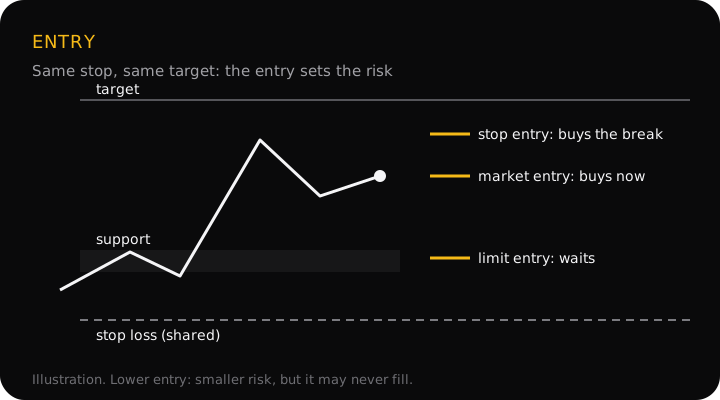
The three ways to enter
- Market entry. Buy or sell now at the current price. It always fills, but you take whatever price is there, including any slippage in a fast market.
- Limit entry. A pending order to buy below the current price or sell above it. It is how you enter on a retest or a pullback into a zone. Better price, but no fill if price turns early.
- Stop entry. A pending order to buy above the current price or sell below it, so you only get in if price breaks a level. It confirms the move but pays up for it, and a sweep can fill it and reverse.
Whichever you use, the stop loss comes from the chart first: where the idea is proven wrong. The entry is then chosen so that the distance to the stop and to the target makes sense.
What traders disagree on
- One price or a zone. Some plans give a single entry; others give a zone and leave the exact fill to you.
- Confirmation or anticipation. Confirmation traders wait for a close, a break or a lower-timeframe signal and accept a worse price. Anticipation traders place limits at the level and accept that some of them fill on trades that fail.
- Scaling in. Splitting one position across two or three entries gives an average price that depends on how many fill. If you scale in, size the whole position from the worst case: all orders filled and the stop hit.
StraviFX gives one entry level with each setup, so the stop distance, the ratio and the lot size are all measured from the same price.
A worked example
A 4-hour USD/JPY chart, a sell. The prices are an illustration, not real data. A JPY pip is 0.01.
- The plan: stop at 151.80, above the swing high; target at 150.20, the next low. Price is at 151.20 now; a zone the idea sells from sits at 151.50.
- Market entry at 151.20: 60 pips of risk, 100 pips of reward, 1:1.67.
- Limit entry at 151.50: 30 pips of risk, 130 pips of reward, 1:4.33.
- Sized at 1% of a $2,000 account ($20): a USD/JPY pip is worth about $6.60 per standard lot at these prices (100,000 × 0.01 ÷ price). The market entry allows 0.05 lots, risking about $20 to make about $33. The limit entry allows 0.10 lots, risking about $20 to make about $86.
Same idea, same stop, same target, same dollar risk. The limit entry pays well over twice as much if it fills, and nothing if price rises only to 151.40 before falling to the target without it. The pip calculator and the lot size calculator do this for any pair.
Why it matters
Beginners spend most of their time on direction: up or down. But a right call entered late can still lose money over time, because it risks a lot to make a little and needs a high win rate to break even. The entry is where direction turns into numbers, and the risk-to-reward ratio shows whether those numbers are worth it.
Common mistakes
- Chasing. Entering after a big candle because the move "is happening". The stop is now far away and the target close.
- Picking the entry first, then a stop that fits. Shrinking the stop to make a late entry look good puts it inside normal price noise. Move the entry, not the stop.
- Forgetting the spread. Buys fill at the ask, sells at the bid. On a tight plan, a 2-pip spread changes the ratio.
- Not resizing. A different entry means a different stop distance, which means a different lot size. Recalculate every time.
Questions
Should I use a market order or a limit order to enter?
A market order fills now at the current price, so you never miss the trade but often pay more. A limit order waits for a better price, so the risk is smaller but the trade may never fill. Use a limit when your plan names a level; use market when the reason to enter is happening now and the ratio still works.
What is an entry zone?
A range of prices where the setup is valid, such as an order block or the optimal trade entry band, instead of one exact price. Many traders still place a single order inside it, often at the edge nearest the market for more fills, or the middle for a better ratio.
Why didn't my buy limit fill when price touched my level?
Most charts plot the bid price, but a buy fills at the ask, which is higher by the spread. If price touched your level on the bid chart, the ask may have stayed a pip or two above it. Some traders place buy limits a little above the level for this reason.
Can I move my entry after placing the order?
You can change a pending order until it fills. Moving it to chase price is the usual mistake: it widens the stop distance and shrinks the reward. If you move the entry, recalculate the lot size and the ratio before you do.
Entries in the app
Each StraviFX setup comes with one entry price, a stop loss and two targets, with the pips and the ratio for each, and the lot size for your account and risk. On Premium's extended analysis, when price at market is too far from the level that would prove the idea wrong to reach a target of at least 1.5 times the risk, the plan uses a pullback entry closer to that level instead of shrinking the stop. The app never places the trade; the decision stays with you.
Get StraviFX
Point your camera at any chart and StraviFX reads the structure, plans the entry, stop and targets, and sizes your risk. Free to download on Android, with optional subscriptions.