Glossary · Zones
Fair Value Gap (FVG)
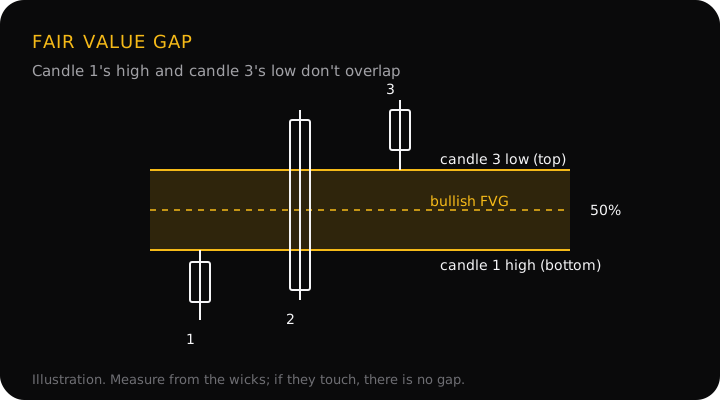
A fair value gap (FVG) is a gap inside a three-candle move: the middle candle moves so fast that the first candle's high and the third candle's low don't overlap. Price went through that space mostly one way, so traders watch it as an area it may come back to.
How to mark one
Look at any three candles in a row and compare the outer two. The middle candle doesn't matter except as the cause.
- Bullish FVG: the third candle's low is above the first candle's high. The gap runs from candle 1's high (bottom) to candle 3's low (top).
- Bearish FVG: the third candle's high is below the first candle's low. The gap runs from candle 3's high (bottom) to candle 1's low (top).
Use the wicks, not the bodies. If the wicks of candle 1 and candle 3 touch or overlap, there is no gap, however big the middle candle is. Gaps on higher timeframes are fewer and usually watched more closely.
How traders use it
- As an entry zone. In an uptrend, a pullback into a bullish gap is a place to look for a buy, with the stop below the gap or below the swing low that started the move.
- As a target. An unfilled gap behind price is somewhere price may return to. This is part of what ICT teaching calls internal range liquidity, against the outer highs and lows covered on the buy-side / sell-side liquidity page.
- As proof of a strong move. A gap shows the move was one-sided. Many traders only trust an order block or a break of structure when the move away left one.
There is no agreed rule for when a gap stops counting. Some traders drop it after the first touch, some at the 50% line, some only once a candle closes beyond its far side. Pick one and keep it.
A worked example
A 4-hour gold (XAU/USD) chart. The prices are an illustration, not real data.
- The gap: candle 1 trades between 4,026.00 and 4,031.00. Candle 2 rallies from 4,028.00 to 4,066.00. Candle 3 trades between 4,047.00 and 4,071.00. Candle 3's low (4,047.00) is above candle 1's high (4,031.00), so there is a bullish gap from 4,031.00 to 4,047.00, $16.00 wide, with its midpoint at 4,039.00.
- The trade idea: price pulls back into the gap and a 1-hour candle closes up at 4,043.00. A buy there, with the stop at 4,023.00 (below candle 1's low, the start of the move), risks $20.00 an ounce. The target is the high from earlier in the week at 4,083.00, $40.00 away: 1:2.
- The size: one standard lot of gold is 100 ounces, so a $20.00 stop costs $2,000 per lot. Risking $40 gives 0.02 lots; at the target the gain would be $80.
- If it fails: a 4-hour close below 4,031.00 means the gap has been run straight through. The buy idea is weaker, and the stop is close.
The lot size calculator and pip calculator handle gold's 100-ounce lot for you.
Why it matters
A fair value gap is one of the few smart-money ideas with an exact rule: two numbers either overlap or they don't. That makes it easy to mark the same way every time and to check later in a journal. It also explains why price so often comes back to an area it left in a hurry, before carrying on.
Common mistakes
- Measuring from the bodies. The gap is between wicks. Bodies make gaps look bigger than they are, and some aren't gaps at all.
- Buying every bullish gap. Small timeframes print gaps all day. Without a trend and a reason above it, a gap is just a fast candle.
- Expecting the gap to be filled exactly. Price may stop at the edge, the middle, or not come back at all. Plan for each before you enter.
- Confusing it with a weekend gap. A jump between Friday's close and Monday's open is a different thing, with no trading inside it.
Questions
Is a fair value gap the same as an imbalance?
Mostly, yes. Imbalance and inefficiency are other names for it. Some traders keep imbalance for any thin, one-sided stretch of price and fair value gap for the strict three-candle gap, but in everyday use they mean the same thing.
Does a fair value gap always get filled?
No. Many gaps are revisited, which is why traders watch them, but some are never touched again, especially in a strong trend. Treat an unfilled gap as a place price may come back to, not a promise that it will.
What does filled mean, exactly?
Traders use it loosely. A full fill means price has traded right through the gap. A partial fill means it has traded into it but not through it. Many watch the halfway point, which ICT teaching calls consequent encroachment, as the level where a gap is half filled.
Is a fair value gap the same as a weekend gap?
No. A weekend gap is a jump between one candle's close and the next candle's open, with no trading in between. A fair value gap forms while the market is open: price did trade through it, just quickly and mostly in one direction.
Fair value gaps in the app
StraviFX's hourly Swing signals check (Premium, monthly plans and longer) uses the strict three-candle rule on the 4-hour chart: a bullish gap when the last closed 4-hour candle's low is above the high of the candle two before it, and the mirror image for a bearish gap. It only looks at the gap formed by the three most recent closed 4-hour candles. A setup also needs the daily trend to agree, a sweep or break of structure, a strong 4-hour candle, and a 1-hour candle that closes inside the gap in the trade's direction. These are rules for reading a chart, not predictions; the decision stays with you.
Get StraviFX
Point your camera at any chart and StraviFX reads the structure, plans the entry, stop and targets, and sizes your risk. Free to download on Android, with optional subscriptions.