Glossary · Zones
Premium and discount
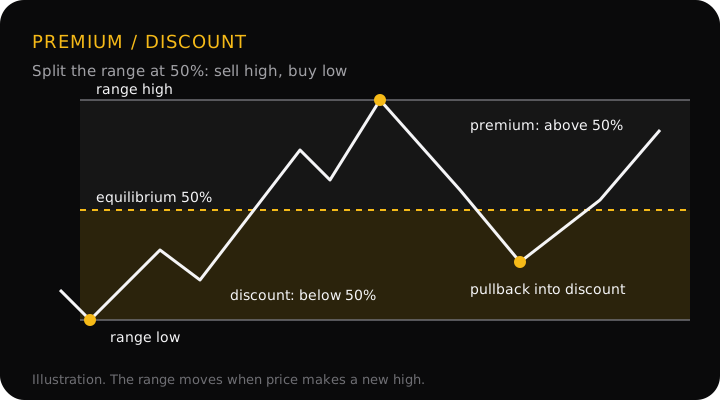
Premium and discount split a price range in half: above the midpoint is premium (expensive), below it is discount (cheap), and the midpoint itself is equilibrium. The rule that follows is to buy in discount and sell in premium, because a buy below the midpoint risks less for the same target than a buy above it.
How to mark premium and discount
- Pick the range. Use the swing low and swing high of the latest leg that did something meaningful: broke structure or swept liquidity. Smart-money traders call it the dealing range. Mark the ends from the wicks, as you would any swing point.
- Find the midpoint. Equilibrium = (range high + range low) ÷ 2.
- Read the halves. Above equilibrium is premium; below it is discount. In a bullish range you look for buys in discount. In a bearish range you look for sells in premium.
When price makes a new high (or low) beyond the range, the range extends and the midpoint moves with it. Premium and discount are always relative to a range, never fixed prices.
What traders disagree on
- Which range. This is the big one, and it is a judgment call. Minor swings give a midpoint that means little; the same price can be discount on one timeframe and premium on another.
- Is halfway deep enough? Some traders split each half again, at 25% and 75%, and treat the outer quarters as "deep" discount or premium. Others wait for the 62–79% retracement band called the optimal trade entry.
- Whether it is a filter or a signal. Most treat it as a filter: a reason not to buy high, not a reason to buy low on its own.
StraviFX's glossary uses the plain 50% split. Whatever range rule you choose, decide it before you look for the trade, not after, or you will always find a range that says "discount".
A worked example
A 4-hour GBP/USD chart. The prices are an illustration, not real data.
- The range: a bullish leg from a swing low at 1.2600 to a high at 1.2800 that broke structure. Equilibrium is (1.2800 + 1.2600) ÷ 2 = 1.2700. Above it is premium; below it, discount.
- The plan: buy, with the stop at 1.2585 (15 pips below the swing low) and the target at the range high, 1.2800.
- Buy A, in premium at 1.2760: 175 pips of risk for 40 pips of reward, 1:0.23. On a $2,000 account risking 1% ($20), that is 0.01 lots (rounded down), risking $17.50 to make $4.
- Buy B, in discount at 1.2660: 75 pips of risk for 140 pips of reward, 1:1.87. The same $20 buys 0.02 lots, risking $15 to make $28.
Same market, same stop, same target. Only the entry changed, and it decided whether the trade was worth taking. The risk-reward calculator and the lot size calculator do this math for any levels.
Why it matters
Premium and discount put a number on the old rule: buy low, sell high. Buy A above is a common beginner trade: the direction is right, but it buys after the move, risks a lot to make a little, and needs to win about four times out of five just to break even. Checking where price sits in its range takes a few seconds and filters out those trades.
Common mistakes
- Buying discount in a downtrend. In a bearish range, discount is where sellers take profit, not where you buy. The trend decides which half you trade from.
- Drawing the range from minor swings. A range made of two small wiggles gives a midpoint that means nothing. Use swings that broke structure or took liquidity.
- Treating discount as a signal. Price in discount only means it is cheap relative to the range. Wait for a reason to buy there, such as an order block or a sweep of a low.
- Waiting forever. Strong trends often don't pull back that far. If price never reaches discount, there was no trade under your rules, and that is fine.
Questions
Is equilibrium the same as the 50% Fibonacci retracement?
Yes. Equilibrium is the halfway point of the range, which is exactly where a Fibonacci tool drawn from the same swing low to swing high puts its 50% level. The names differ; the price is the same.
Can you ever buy in premium?
You can, and in a strong trend price may never pull back to discount. But a buy in premium pays up: with the stop below the range and the target at its high, the risk is large and the reward small. Many traders who buy in premium do it only when a smaller range inside it shows discount.
Does price always return to equilibrium?
No. Trending markets can stay on one side of the midpoint for a long time and form new ranges before the old midpoint is revisited. Equilibrium is a reference for where the cheap and expensive halves meet, not a target price is obliged to reach.
Which timeframe do premium and discount apply to?
Any timeframe, because they come from whatever range you draw. That is also the catch: a price can be in discount on the 4-hour range and in premium on the daily. Use the range on the timeframe you plan the trade on, and know where price sits on the one above it.
Premium and discount in the app
The StraviFX glossary defines premium and discount so you can follow any reading that mentions them, and every term in an analysis links to its definition. The same idea sits inside Premium's extended analysis: each target must be at least 1.5 times the risk from entry, and when price at market is too far from the level that invalidates the idea, the plan uses a pullback entry closer to that level instead of shrinking the stop. The decision stays with you.
Get StraviFX
Point your camera at any chart and StraviFX reads the structure, plans the entry, stop and targets, and sizes your risk. Free to download on Android, with optional subscriptions.