Glossary · Liquidity
Liquidity sweep / stop hunt
A liquidity sweep, or stop hunt, is a sharp push past an obvious high or low that triggers the stop orders resting there, then reverses instead of continuing. The candle's close decides it: back inside the level is a sweep, beyond it is a breakout.
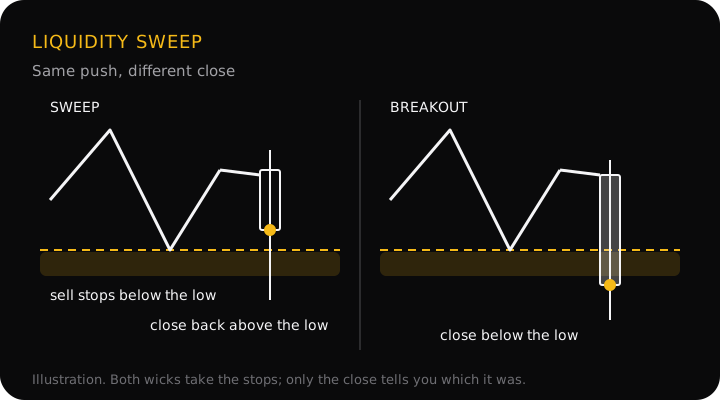
What happens in a sweep
Stop orders pool just beyond obvious highs and lows (the liquidity page explains where and why). When price reaches them, they turn into market orders: sell stops below a low become selling, buy stops above a high become buying. If that burst of orders is all there was, price runs out of fuel and comes straight back. That push and return is the sweep.
A sweep of a low takes sell-side liquidity; a sweep of a high takes buy-side liquidity. Flat edges such as equal highs are common targets because so many stops sit behind them.
Sweep, false breakout or breakout
Three things can happen after price trades through a level. Only the closes tell them apart.
| What you see | Close | Reading |
|---|---|---|
| Wick through the level | Back inside, same candle | Sweep |
| Close beyond, then back inside | Beyond, then inside a few candles later | False breakout |
| Close beyond, and it holds | Beyond, and later candles stay there | Breakout |
Traders don't agree on the timing. Some count a sweep only when the same candle closes back inside; others accept a rejection that plays out over two or three candles, which overlaps with what other traders call a false breakout. StraviFX uses the strict version: the candle that trades through the level must close back inside it. A candle that closes beyond the level is a break, the same close rule used for a break of structure.
A worked example
On a 4-hour EUR/USD chart, the last confirmed swing low is 1.0850. The prices are an illustration, not real data.
- The sweep: a candle trades down to 1.0832, 18 pips below the low, triggering the sell stops there, then closes at 1.0861, back above 1.0850. The low was swept, not broken.
- The trade idea: a buy at 1.0861 after the close, with the stop at 1.0827, 5 pips beyond the sweep wick (34 pips of risk), and the target at the last swing high, 1.0929 (68 pips). That is a 1:2 risk-to-reward.
- The size: on a $2,000 account risking 1% ($20), 34 pips at $10 a pip per standard lot gives 0.058 lots, rounded down to 0.05 lots. The money at risk is then $17.
- The breakout version: if the same candle had closed at 1.0838 instead, below the low, the level would be broken and the buy idea gone. The low pointed the other way.
The lot size calculator works out the size for any stop distance.
Why it matters
A sweep is one of the clearest moments on a chart: the stops are gone, the push failed, and you know exactly where you are wrong (past the tip of the wick). It also explains why beginners so often get stopped out a few pips beyond an obvious low just before price turns their way. Their stop was part of the pool.
Common mistakes
- Calling it before the close. A candle that has spiked through a low can still close below it. Until it closes, it is neither a sweep nor a break.
- Seeing sweeps at levels nobody watches. A sweep needs an obvious level with stops behind it: a confirmed swing high or low, equal highs or lows, or a range edge. A random wick is just a wick.
- Trading every sweep against the trend. A sweep of a low inside a strong downtrend is often a pause before the next leg down. Check the higher timeframe first.
- Putting the stop inside the wick. If price goes back to the tip of the sweep, the idea has failed. A stop above the tip gets taken on noise before that is known.
Questions
Is a liquidity sweep the same as a stop hunt or a liquidity grab?
Yes, they describe the same candle shape. Liquidity sweep is the more neutral name. Stop hunt suggests someone went after the stops on purpose, which no chart can prove, so the StraviFX glossary lists stop hunt, stop run and liquidity grab as other names for a sweep.
How far past the level does price have to go?
There is no fixed distance. Any trade beyond the level triggers the stops resting just past it, so even a few pips can count. What matters is that the level was obvious and that the candle closed back inside it. A long wick with a close back inside is a clearer sweep than a one-pip poke.
Does a sweep always mean price will reverse?
No. A sweep shows that the stops beyond a level were taken and that the push didn't hold. Price can still come back and break the level properly later. Treat a sweep as one reason for a trade idea, checked against the trend on a higher timeframe, not as a signal on its own.
Where does the stop loss go on a trade after a sweep?
Beyond the tip of the sweep wick, with a few pips of room, because a move past the wick means the sweep has failed. Then size the position for that distance so the money at risk stays the same.
Sweeps in the app
StraviFX's hourly Swing signals check (Premium, monthly plans and longer) tests the last closed 4-hour candle for a sweep: its low below the last confirmed swing low and its close back above it, or the mirror image at a swing high. A sweep alone isn't enough. The check also wants the daily trend to agree and a strong candle in the new direction, with a body at least 1.1 times the average 4-hour range over the last 14 candles. A break of structure can stand in for the sweep. These are rules for reading a chart, not predictions; the decision stays with you.
Get StraviFX
Point your camera at any chart and StraviFX reads the structure, plans the entry, stop and targets, and sizes your risk. Free to download on Android, with optional subscriptions.