Glossary · Structure
Swing high and swing low
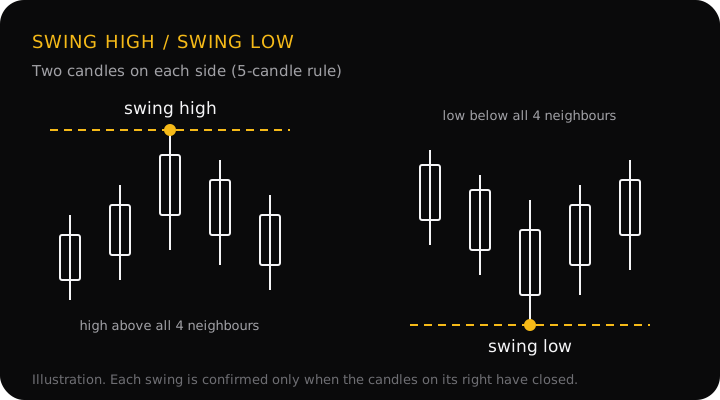
A swing high is a candle whose high is above the highs of the candles on either side of it. A swing low is a candle whose low is below the lows on either side. Trends, breaks and stop placements are all measured from these pivots, so your swing rule shapes every reading.
How many candles make a swing?
There is no single standard. The rule is how many candles on each side the middle candle has to beat:
- One on each side (3 candles). The simplest rule, and the one the StraviFX glossary uses. It marks many swings, including small ones inside a pullback.
- Two on each side (5 candles). A common default in charting indicators. It skips minor wiggles and marks the swings most traders would draw by eye.
- Three or more on each side. Stricter still, for noisy markets or for the main swings only. StraviFX's hourly Swing signals check uses three candles on each side on the 4-hour chart.
A wider rule gives fewer, more meaningful swings, but each one is confirmed later. Whatever you choose, use the same rule on every chart you compare, or your highs and lows won't line up with your own past analysis.
A swing is confirmed late
A candle can't be a swing high until the candles to its right have closed below it. With one candle on each side, you know one candle later; with three on each side, three candles later. On a 4-hour chart, that is 12 hours after the high itself was printed.
This delay is built into the idea, not a flaw in your chart. It is also why some indicators appear to "repaint": they mark the newest high straight away and move the marker if a later candle goes higher.
A worked example
Five 1-hour EUR/USD candles have these highs, in order. The prices are an illustration, not real data.
- 1.0851
- 1.0858
- 1.0866
- 1.0862
- 1.0855
- One-candle rule: candle 3 (1.0866) is above candle 2 (1.0858) and candle 4 (1.0862), so it is a swing high. It is confirmed when candle 4 closes.
- Two-candle rule: 1.0866 is also above candles 1 and 5, so it is a swing high under this rule too, confirmed when candle 5 closes.
- If candle 4 had reached 1.0866: the two candles would tie. Under a strict rule, neither is a swing high, because neither is above both of its neighbours.
Why it matters
Every other structure term is built from swings. Higher highs and higher lows compare one swing with the last. A break of structure is a close beyond one. A sensible stop loss usually sits just beyond one. If two traders define swings differently, they can look at the same chart and disagree about the trend, and both be applying their rule correctly.
Common mistakes
- Marking a swing before it is confirmed. The newest high on the chart is a candidate until the candles on its right have closed.
- Changing the rule between charts. A 1-candle swing on one chart and a 5-candle swing on another give readings you can't compare.
- Using bodies for some swings and wicks for others. Measure swing highs and lows from the wicks, consistently.
- Treating every small swing as important. On a fast chart, a 1-candle rule marks swings inside swings. Decide whether you are reading the main swings or the small ones inside a pullback.
Questions
Is a swing high measured from the wick or the body?
From the wick: a swing high uses the candle's high and a swing low uses its low, because those are the prices the market actually reached. Breaks are different. In the StraviFX glossary, a swing is only broken when a later candle closes beyond it.
How many candles make a swing, 3 or 5?
Both are common, and neither is wrong. A 3-candle swing has one candle on each side; a 5-candle swing has two on each side and marks fewer, more important points. Pick one rule and use it every time, because changing it changes every structure reading you make.
Why did my indicator move a swing point after the fact?
Because a swing can only be confirmed once the candles on its right have closed. Until then the newest high is only a candidate, and the next candle can go higher and replace it. Indicators that draw swings early and then redraw them are showing that delay.
What if two candles have the same high?
Conventions differ. Some tools pick one of them; StraviFX's swing engine requires the high to be strictly above its neighbours, so two equal tops side by side don't make a swing high. Equal highs matter in their own right, because traders often see stop orders resting above them.
Swings in the app
When StraviFX reads a chart, it describes the swings and the structure they form in plain English. On Premium, the extended analysis anchors its levels to that structure. The read is analysis, not a signal to trade; the decision stays with you.
Get StraviFX
Point your camera at any chart and StraviFX reads the structure, plans the entry, stop and targets, and sizes your risk. Free to download on Android, with optional subscriptions.