Glossary · Structure
Market Structure Shift (MSS)
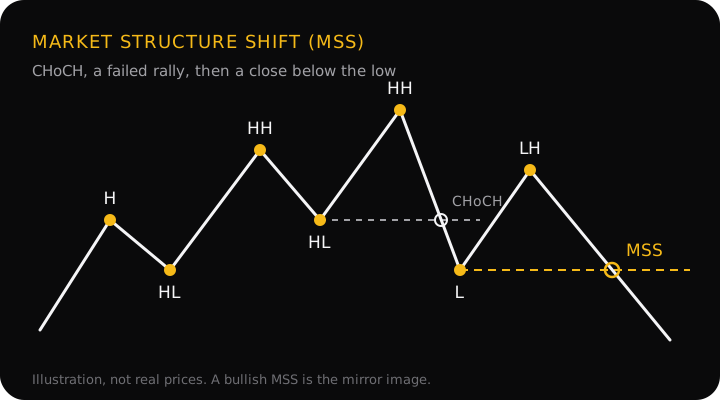
A market structure shift (MSS) is a confirmed flip in direction: structure breaks against the old trend and then starts printing highs and lows in the new direction. It follows a change of character, once price fails to make a new extreme in the old direction: the point where a reversal can be planned.
Three meanings of MSS
"Market structure shift" has no single agreed definition. When you read about it, check which of these the author means:
- Another name for a CHoCH. Some traders and indicators use MSS and change of character for the same first break against the trend.
- A CHoCH with displacement. In many ICT-style guides, a break only counts as an MSS when a large, fast candle closes through the level, often after a liquidity sweep. A slow break without that candle is called a CHoCH.
- The confirmed flip. The old trend breaks, the next swing fails in the old direction, and price then closes beyond the following swing. This is the meaning the StraviFX glossary uses.
The three overlap more than they differ: all of them describe price breaking structure against the trend. The difference is how much evidence each one waits for.
The StraviFX sequence
For a bearish shift, after an uptrend:
- CHoCH. A candle closes below the last higher low.
- A new low forms. Price makes a swing low below the broken level.
- A lower high. The next rally turns before it reaches the last high. The buyers have failed to make a new extreme.
- MSS. A candle closes below the swing low from step 2. Price now has a lower high and a lower low: bearish structure.
A bullish shift is the mirror image: a close above the last lower high, a higher low, then a close above the swing high in between. As with every break in the StraviFX glossary, the candle has to close beyond the level; a wick that pokes through and closes back does not count.
A worked example
GBP/USD on the 1-hour chart has been making higher highs and higher lows. The last high is 1.3120 and the last higher low is 1.3060. These prices are an illustration, not a trade idea.
- CHoCH: a candle closes at 1.3052, below 1.3060.
- New low: price falls to 1.3035 and bounces.
- Lower high: the bounce stalls at 1.3095, 25 pips short of 1.3120.
- MSS: a candle closes at 1.3028, below 1.3035. The structure is now bearish.
The lower high at 1.3095 is now the level that would prove the shift wrong: a close above it would put price back into its old range. That is why traders who sell after an MSS often place the stop loss just beyond the lower high. From a sell at 1.3028, a stop at 1.3100 is 72 pips away, and the lot size calculator turns that distance into a position size for your account.
Why it matters
A change of character tells you a trend-following trade has lost its reason. An MSS is the first point where a trade in the new direction has one: a structure to follow and a swing that marks where the idea is wrong. Waiting for it costs some of the move, because the shift confirms after price has already turned, but it filters out many of the CHoCHs that turn out to be deep pullbacks.
Common mistakes
- Mixing up the meanings. A course that calls the first break an MSS and a glossary that calls it a CHoCH are describing the same candle. Check the definition before you copy a rule.
- Calling an MSS on a wick. A spike below the low that closes back above it is more often a stop sweep than a shift.
- Ignoring the higher timeframe. A 5-minute MSS inside a 4-hour uptrend usually marks the end of a pullback, not a new 4-hour downtrend.
- Using the wrong swing for the stop. The level that invalidates a bearish shift is the lower high, not the old high further up the chart.
Questions
What is the difference between a CHoCH and an MSS?
In the StraviFX glossary, a change of character is the first close against the trend, and a market structure shift is the confirmation that follows: a failed swing in the old direction and then a close beyond the next swing. A CHoCH says the trend may be ending; an MSS says the structure now points the other way.
Does an MSS need displacement?
Many ICT-style traders say yes: the break should come from a large, fast candle that closes well beyond the level, not a slow drift. Others don't require it. A strong candle is useful evidence, but it is not part of the StraviFX definition, which only asks for the failed swing and the close.
Does an MSS need a liquidity sweep first?
No. Some traders give more weight to a shift that starts with price spiking beyond an old high or low and snapping back, because it suggests stops were taken first. It is an extra condition some strategies add, not part of the definition.
Is a market structure shift a guaranteed reversal?
No. An MSS can fail like any other pattern: price can recover and close back beyond the lower high (or higher low) that defined it. It is the point where a reversal can be planned with a clear invalidation level, not a promise about where price goes next.
Market structure shifts in the app
When StraviFX reads a chart, it describes the structure in plain English and links each term, MSS included, to its definition. If the chart shows a break with no confirmation yet, standing aside is one of its possible calls. The read is analysis, not a signal to trade; the decision stays with you.
Get StraviFX
Point your camera at any chart and StraviFX reads the structure, plans the entry, stop and targets, and sizes your risk. Free to download on Android, with optional subscriptions.