Glossary · Structure
Range / consolidation
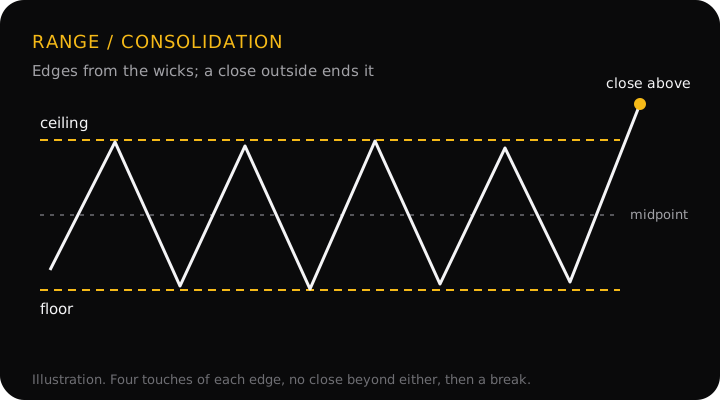
A range, also called consolidation, is price moving back and forth between a ceiling and a floor without making progress in either direction. The highs and lows stop trending and line up along two edges. Trend strategies struggle here, and a range often comes before a larger move, so it is usually a reason to wait.
How to spot a range
A range is what market structure looks like when it is neither bullish nor bearish. Instead of higher highs and higher lows, or lower highs and lower lows, you see:
- Swing highs at about the same price. They form the ceiling. Mark it from the wicks, the highest prices reached.
- Swing lows at about the same price. They form the floor, also marked from the wicks.
- No close beyond either edge. Wicks can poke through; candle bodies keep closing back inside.
A quick way to tell a range from a pullback: in a pullback the last swing in the trend direction is still being exceeded. In a range, new swings keep stopping at the same two prices.
When a range ends
StraviFX uses one rule for every level: it counts as broken only when a candle closes beyond it. So a range ends on the first close outside the ceiling or the floor. That close is a break of structure for whichever side wins.
A wick through an edge that closes back inside is something else. Stop orders tend to rest just beyond a range's edges, and a spike that triggers them and snaps back is often called a sweep (see liquidity). Treat it as a sign the edge was tested, not broken.
A worked example
On a 1-hour GBP/USD chart, two swing highs top out at 1.2708 and 1.2710, and two swing lows bottom at 1.2652 and 1.2650. The prices are an illustration, not real data.
- The edges: ceiling 1.2710, floor 1.2650, so the range is 60 pips tall. The midpoint is 1.2680.
- A plan at the floor: buy at 1.2655, stop at 1.2635 (15 pips below the floor), target 1.2700 (just under the ceiling). That risks 20 pips to make 45, a reward-to-risk ratio of 1:2.25, which needs a win rate above about 31% to break even.
- The same plan from the midpoint: buy at 1.2680 with the same stop and target, and you risk 45 pips to make 20, 1:0.44. That is why the middle of a range is the worst place to enter.
- When the plan is off: a 1-hour close below 1.2650 ends the range, and the buy idea with it.
You can check numbers like these in the risk reward calculator.
Why it matters
Most trend tools assume a trend. In a range they give a stream of breakouts that fail and pullbacks that never resume, which is where many beginners lose a week of gains. Recognising a range tells you to change plans: trade the edges with tight stops, or step aside until price closes outside. Ranges also tend to come before larger moves, so the break, when it comes, is worth being ready for.
Common mistakes
- Calling a range after one touch. A single high and a single low are a pullback until a second swing stops at the same place.
- Treating a wick as a breakout. Wait for a close outside the edge. Wicks through range edges are common, and many reverse.
- Entering in the middle. There is no level to put a stop behind, and the reward-to-risk is poor in both directions.
- Putting the stop exactly on the edge. The obvious price just beyond an edge is where many other stops sit. Leave room beyond it, and size the position for that distance.
Questions
Is consolidation the same as a range?
Mostly, yes. Traders say range for a clear sideways box with well-tested edges, and consolidation for any pause after a move, which may be a tight box or a small flag. The StraviFX glossary treats them as one term: price stops making higher highs and higher lows, or lower highs and lower lows, and moves between two edges.
How many touches make a range?
There is no fixed number. Two swing highs at roughly the same price and two swing lows at roughly the same price is the usual minimum, because one touch of each is just a pullback. More touches make the edges clearer, and also put more stop orders just beyond them.
How do I know when a range has ended?
When a candle closes beyond one of its edges. A wick that pokes through and closes back inside doesn't end the range; it often marks a liquidity sweep instead. After a close outside, a retest of the broken edge from the other side is the usual next thing to watch.
Should I trade inside a range or wait for the breakout?
Both are valid plans, and neither is safer by default. Trading the edges means buying near the floor and selling near the ceiling, with a stop just outside. Waiting means doing nothing until a close outside, then planning with the trend that follows. Trading the middle of the range is the one choice with no edge to lean on.
Ranges in the app
StraviFX describes a chart's structure in plain English, and a range is one of the three readings, next to bullish and bearish. Stand aside is one of its three possible calls, next to buy and sell, so a sideways chart doesn't have to be forced into a trade. The read is analysis, not a signal to trade; the decision stays with you.
Get StraviFX
Point your camera at any chart and StraviFX reads the structure, plans the entry, stop and targets, and sizes your risk. Free to download on Android, with optional subscriptions.