Glossary · Execution
Invalidation
Invalidation is the price or condition that proves a trade idea wrong, whatever happens afterwards. You decide it before entering: for a buy, usually a candle close below the swing low the idea rests on. The stop loss is the order that acts on it, placed a little beyond it.
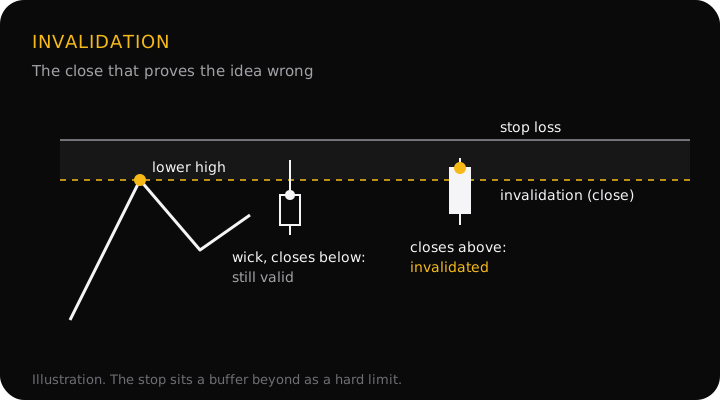
Invalidation and the stop loss
The two are often used as one word, but they do different jobs. Invalidation is a judgement about the chart: for a sell under a lower high, the idea is that sellers are in control, and a candle close above that high says they aren't. The stop loss is the order that caps the loss if you are wrong. It goes a buffer beyond the invalidation level, because price often sweeps just past an obvious level before turning.
So the order of work is: find the invalidation, put the stop beyond it, then size the trade from the stop distance with the lot size calculator.
Three ways an idea is proven wrong
- Price. A close beyond the level the idea rests on: the swing low under a buy, the swing high over a sell, the far edge of an order block. This is the one most traders use, and the easiest to check.
- Condition. Something the idea needs fails to happen. A breakout trade expects price to hold outside the old range; a close back inside says the breakout failed, even if the stop is far away.
- Time. Some ideas need to work quickly. A trader might write "if price hasn't moved one risk-unit my way within ten candles, I close it". That is an example of a rule, not a recommended number; test any time limit on your own trades.
Invalidated before you get in
A plan with a pending order can be proven wrong before it fills. If you are waiting to sell a pullback at 1.2820 and price closes above your invalidation level first, the setup is gone: cancel the order. It isn't a loss, because you never had the trade, and it isn't a reason to sell higher up instead.
The opposite happens too. If price falls all the way to your target without ever coming up to your entry, the setup is missed. Selling late at a worse price is a different trade, with a worse ratio, and needs its own plan.
A worked example
A 4-hour GBP/USD sell. The prices are an illustration, not real data. The trend is down and the last lower high is 1.2850.
- The plan: sell limit at 1.2820. Invalidation: a 4-hour close above 1.2850. Stop: 1.2865, 15 pips beyond it. Risk: 45 pips.
- Case 1, a wick: after the fill, a candle spikes to 1.2860 and closes at 1.2835. No close above 1.2850 and the stop wasn't touched, so the idea stands and the trade stays open.
- Case 2, a close: a candle closes at 1.2855. The idea is invalidated, though the stop at 1.2865 hasn't been hit. Closing at the market there loses 35 pips instead of 45.
- Case 3, a fast move: a news candle runs straight through 1.2865. The stop closes the trade before any candle can close, which is why the stop exists alongside the close rule.
The close rule handles the ordinary case; the stop handles the case where waiting for a close would cost too much.
What traders disagree on
- Close or wick. Some treat any trade through the level as invalidation and let the stop sit right on it; others wait for a candle close, which avoids sweeps but needs a hard stop further out.
- Which timeframe's close. A close on the 1-minute chart and a close on the 4-hour chart are very different events. Most traders use the timeframe the setup came from.
StraviFX counts a level as broken only on a candle close, and puts the stop a buffer beyond the invalidation level so it caps the loss when price moves too fast to wait.
Why it matters
Deciding the invalidation before you enter is what stops a losing trade from being renegotiated into a bigger one. Without it, every move against you invites a new story about why the trade is still fine. With it, the question is simple: has the thing that would prove me wrong happened yet?
Common mistakes
- No invalidation, only a pip number. A 20-pip stop that doesn't sit beyond any level isn't tied to the idea; it is tied to how much you wanted to lose.
- Moving the level after entry. If the chart shows a new reason, that is a new trade. Moving the old level to keep the trade alive is the renegotiation this is meant to prevent.
- Ignoring a close beyond it because the stop wasn't hit. The stop is the last line, not the decision.
- Chasing an invalidated setup with a worse entry in the same direction.
Questions
Is invalidation the same as a stop loss?
No. Invalidation is part of the analysis: the point where the reason for the trade is gone. The stop loss is the order at your broker that gets you out. It usually sits a small buffer beyond the invalidation level, so a quick poke through doesn't close the trade.
Price closed beyond my invalidation but didn't reach my stop. What now?
If your rule says a close beyond the level ends the idea, close the trade at the market. You'll usually lose less than the full stop. Holding on because the stop wasn't touched means trading a reason that no longer exists.
Can I re-enter after a setup is invalidated?
Only as a new trade, with a new reason, a new invalidation level and a new size. The old plan is finished. Re-entering the same direction straight away to win the loss back is the usual way one loss becomes three.
Can a trade be invalidated without hitting a price?
Yes. Some ideas depend on a condition (a breakout should hold above the old range) or on time (a sharp move should follow quickly). If the condition fails or the time runs out, the idea is weaker even if no level broke. Write these rules down before the trade.
Invalidation in the app
Every StraviFX analysis says what would invalidate it: the execution ladder marks the stop as the invalidation, and Premium's instant market read has a "What could invalidate this?" line in plain English. The journal handles the before-entry case for you. If price reaches the stop, or TP1, before the entry fills, the setup is marked "Setup invalidated" and isn't counted as a loss or a win. The app never places or cancels orders at your broker; that stays with you.
Get StraviFX
Point your camera at any chart and StraviFX reads the structure, plans the entry, stop and targets, and sizes your risk. Free to download on Android, with optional subscriptions.