Glossary · Risk
Spread
The spread is the gap between the price you can buy at (the ask) and the price you can sell at (the bid). A trade opens on one side and closes on the other, so it starts down by about the spread. It is a cost, usually counted in pips, and it widens around news and in quiet hours.
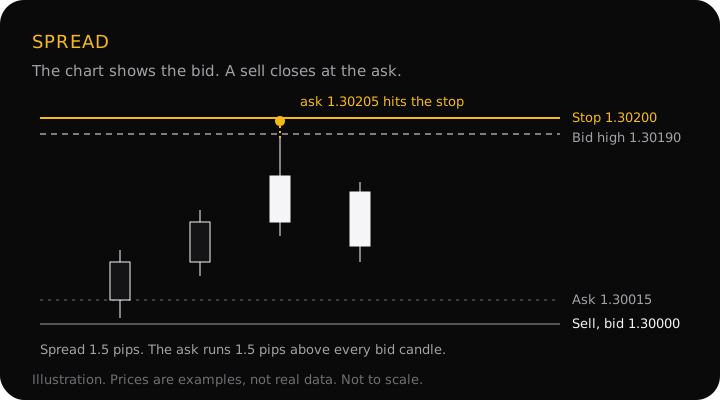
Bid, ask and which one your orders use
The bid is the price you can sell at; the ask (or offer) is the price you can buy at, and it is almost always higher. Investor.gov calls the difference between the two the spread (Investor.gov: ask price).
| Trade | Opens at | Closes at (stop and target too) |
|---|---|---|
| Buy | Ask | Bid |
| Sell | Bid | Ask |
Most charting platforms, including MetaTrader by default, draw candles from the bid. So a buy behaves as drawn when it closes, and a sell doesn't: its stop and target are hit by the ask, which you only see if you switch on the ask line.
A worked example: the sell stop the chart didn't reach
GBP/USD, a 1.5-pip spread. The prices are an illustration, not real data.
- Entry: sell at the bid, 1.30000. The ask is 1.30015.
- Stop: 1.30200, 20 pips above the entry on the chart. It triggers when the ask reaches 1.30200, which is when the bid is 1.30185.
- What the chart shows: the high of the bid candle is 1.30190, one pip below the stop. The trade is closed anyway, because the ask touched 1.30205.
- Target: 1.29600, 40 pips below. It fills only when the ask gets there, so the bid has to reach 1.29585.
The fix is to place a sell's stop a spread further away than the level you marked (and a target a spread short of it), then size from that wider stop with the position size rule. If the news spread is five pips, a stop with a 1.5-pip allowance can still be hit.
What the spread costs
Spread cost = spread in pips × pip value per lot × lots
- EUR/USD, 1.0-pip spread, 0.10 lots: 1.0 × $10 × 0.10 = $1.00 a trade. If the spread is 5 pips during news, $5.00.
- Gold, $0.30 spread, 0.10 lots (10 oz): $0.30 × 10 = $3.00 a trade.
The share of your risk matters more than the dollars. The same 1-pip spread is 10% of a 10-pip stop but 2.5% of a 40-pip one, so tight-stop strategies pay a much bigger cost on every trade. The pip calculator gives the pip value for other pairs.
Kinds of spread and account
- Variable or fixed. Most brokers quote a variable spread that tightens when the market is busy and widens when it isn't. A fixed spread stays the same in normal conditions, usually at a higher level, and the broker's terms say when it can still change.
- Spread only, or raw spread plus commission. Some accounts build the broker's charge into a wider spread; others quote a tighter spread and charge a commission per lot. To compare, turn the commission into pips: on a pair quoted in US dollars a pip is $10 a lot, so a $7 round-trip commission (an illustrative figure) is the same as 0.7 pips.
- When it widens. Around high-impact news, around the daily rollover when liquidity is thin, at the weekly open, and on less traded pairs. That is also when stops get hit by the spread alone.
Why it matters
The spread is a cost you pay before the trade can earn anything, and it eats into risk-to-reward from both ends: the loss at the stop grows by the spread and the profit at the target shrinks by it. On a swing trade with a 40-pip stop that barely shows. On a 10-pip scalp it can turn a strategy that works on the chart into one that loses in the account.
Common mistakes
- Placing a sell's stop exactly at the high. Add the spread, or the ask will take you out at a level the chart never printed.
- Measuring R:R from the chart only. Include the spread in the stop distance before you size the trade.
- Trading the minute of a big release. Spreads can jump to several times normal, and stops and entries fill there.
- Comparing brokers by the lowest advertised spread. "From 0.0 pips" describes the best moment, not the typical one, and may come with a commission.
Questions
Why did my sell stop trigger when the chart never reached it?
Most charts draw the bid price, but a sell closes at the ask, which sits one spread higher. So a sell's stop triggers when the ask reaches it, while the bid candle on your chart can still be a spread below. Around news, when the spread widens, that gap can be several pips.
Do I pay the spread twice, to open and to close?
No, you pay it once per trade. You buy at the ask and sell at the bid (or the other way round), so the round trip crosses the gap once. Some accounts charge a commission on top, usually on both the open and the close.
What is a good spread?
It depends on the market, the broker and the time of day. Major pairs usually have the tightest spreads, crosses and exotics wider ones, and every market widens around big news. Compare a broker's typical spread at the hours you trade, not the lowest figure it advertises.
Does the spread affect a buy trade's stop loss?
Not where it triggers: a buy closes at the bid, which is what most charts show, so its stop triggers as drawn. But the entry was at the ask, a spread above the chart price, so the loss at the stop is the distance you measured on the chart plus the spread.
Spread and the app
StraviFX plans levels from market prices and doesn't know your broker's spread, so on a sell, check that the stop allows for it before you place the order. The plan already puts the stop loss beyond the level that proves the idea wrong, with a buffer, which usually leaves room for a normal spread but not for a news spike.
Get StraviFX
Point your camera at any chart and StraviFX reads the structure, plans the entry, stop and targets, and sizes your risk. Free to download on Android, with optional subscriptions.