Glossary · Risk
Position size / lot
Position size is how much of a market you buy or sell. In forex it is counted in lots: one standard lot is 100,000 units of the base currency, a mini lot 10,000 and a micro lot 1,000. You choose the size from the money you are willing to lose and the stop distance, not from leverage.
Lot sizes at a glance
| Name | Lots | Units | Pip value, USD-quoted pair |
|---|---|---|---|
| Standard | 1.00 | 100,000 | $10 |
| Mini | 0.10 | 10,000 | $1 |
| Micro | 0.01 | 1,000 | $0.10 |
The pip values hold for pairs quoted in US dollars (EUR/USD, GBP/USD, AUD/USD) on a dollar account. For JPY pairs and crosses, a pip is worth a different amount, which the pip calculator works out. Gold is usually 100 ounces per lot, so a $1 move is $100 per lot. Crypto and shares are traded in coins and shares. Brokers can set their own contract sizes, so check the contract specification before you size a trade.
How to size a position
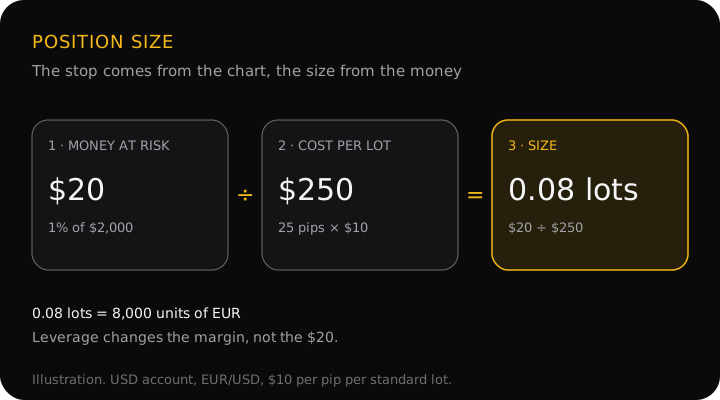
Lots = money at risk ÷ (stop distance in pips × pip value per lot)
- Place the stop on the chart, beyond the level that would prove the idea wrong (see stop loss and invalidation).
- Decide the money at risk, usually a small percentage of the account.
- Divide, then round down to the nearest size your broker allows, so you never risk more than planned.
The lot size calculator does this for forex, JPY pairs and gold.
A worked example: same risk, three markets
A $2,000 account risking 1% ($20) a trade, with a 25-pip or $8 stop. The prices are an illustration, not real data.
- EUR/USD, 25-pip stop: $20 ÷ (25 × $10) = 0.08 lots, which risks exactly $20.
- USD/JPY at 150.00, 25-pip stop: a pip on one lot is ¥1,000, which is $6.67 at 150.00. $20 ÷ (25 × $6.67) = 0.12 lots, which risks $20.
- Gold, $8 stop: $8 × 100 oz = $800 per lot. $20 ÷ $800 = 0.025, rounded down to 0.02 lots, which risks $16 (0.8%). Rounding up to 0.03 would risk $24 (1.2%).
Same account, same risk, three different sizes. That is the point: the size changes so the money at risk doesn't.
Size, margin and leverage
The 0.08 lots of EUR/USD above is 8,000 euros, worth about $8,800 at 1.1000. At 1:100 leverage your broker holds about $88 of margin to keep it open; at 1:500, about $17.60. Either way, if the 25-pip stop is hit, you lose $20. Leverage decides how big a position you can open, not how much you should. Sizing from leverage ("I have 1:500, so I can trade 1 lot") is how a single stop-out takes a large part of a small account.
What traders disagree on
- Fixed percentage or fixed money. Risking 1% of the current balance shrinks your size after losses and grows it after wins; a fixed $20 stays the same until you change it.
- How much to risk. 0.5%, 1% and 2% are all common, and there is no correct figure. Ten losses in a row cost about 4.9% of the account at 0.5% a trade, 9.6% at 1% and 18.3% at 2%.
- Stop first or risk first. Some pick the money first and let it set the stop distance. StraviFX places the stop where the chart says the idea is wrong, then sizes from it, because a stop chosen to fit a budget often sits inside normal price noise.
Why it matters
The stop decides where you are wrong; the size decides how much that costs. Two traders with the same entry, stop and target can have completely different results if one sizes by feel. Sizing from risk is what keeps one loss from wiping out a week, and it is what makes risk-to-reward and R multiples mean the same thing in money from trade to trade.
Common mistakes
- Using the same lot size on every trade. A fixed 0.10 lots risks $15 on a 15-pip stop and $60 on a 60-pip one.
- Using the EUR/USD shortcut on gold. "$10 a pip per lot" is only true for USD-quoted pairs. A gold lot moves $100 for every $1.
- Rounding up. Always round the size down to the nearest allowed step, or you risk more than you planned.
- Sizing from margin or leverage. Free margin tells you what you can open, not what you can afford to lose.
Questions
What is 0.01 lots?
A micro lot: 1,000 units of the base currency. On a pair quoted in US dollars, such as EUR/USD, each pip is worth about $0.10 at that size, so a 20-pip stop risks about $2. It is the smallest size most brokers allow, which matters on small accounts.
Is lot size the same as position size?
In forex, people use them to mean the same thing: lot size is position size counted in lots. Position size is the wider term and also covers ounces of gold, coins of crypto or shares of a stock, which are counted in their own units.
Does higher leverage let me trade bigger safely?
Leverage lets you open a bigger position with less margin, but it doesn't change what the position loses if the stop is hit. That loss depends only on the size and the stop distance. Sizing from the stop and your risk keeps the loss the same whatever leverage the account has.
What if my calculated size is below 0.01 lots?
Then even the smallest position risks more than you planned on that stop. Your choices are to skip the trade, find a setup with a tighter stop that is still in a sensible place, or accept the larger risk knowingly. Don't squeeze a well-placed stop just to make the size fit. The lot size calculator shows when this happens.
Position size in the app
The lot size calculator in StraviFX is free. It sizes from your account equity, your risk percentage and the setup's entry and stop, and works in money terms (contract size × stop distance × currency conversion), so gold, crypto and stocks are sized with their own contract sizes instead of the forex shortcut. It rounds down to 0.01 lots for forex and metals, to whole shares for stocks and to small fractions for crypto, then shows what the rounded size actually risks. It flags any risk above 2% and caps the input at 10%. It assumes a US dollar account. The app never opens positions; you enter the size at your broker.
Get StraviFX
Point your camera at any chart and StraviFX reads the structure, plans the entry, stop and targets, and sizes your risk. Free to download on Android, with optional subscriptions.