Glossary · Execution
Confluence
Confluence is when several independent reasons point to the same trade at the same price, for example an order block inside a discount zone just after a liquidity sweep. It works as a filter: more confluence means fewer trades, not guaranteed winners, and two signals built from the same data count as one reason.
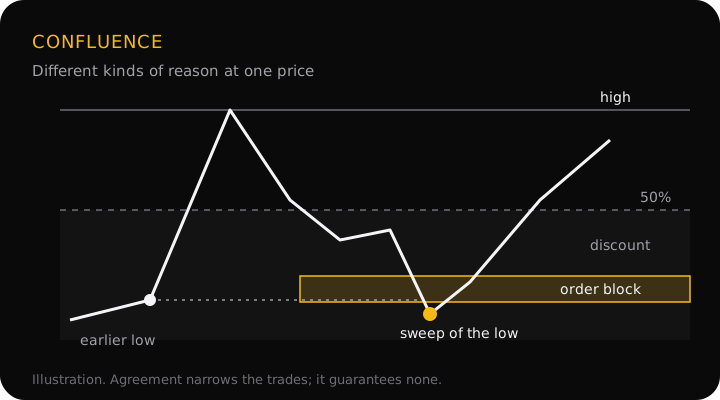
Independent reasons, not the same reason twice
Confluence only adds information when each reason could have been wrong on its own. A simple way to check is to sort every reason into a family and count one per family:
- Direction: market structure on your timeframe and the one above it.
- Location: a zone such as an order block, demand zone, fair value gap or the discount half of the range.
- Liquidity: a sweep of the stops beyond an obvious high or low.
- Momentum: indicators such as RSI, MACD or stochastic, which are all built from recent closes.
Several tools in one family tell you the same thing more loudly. An order block, a fair value gap and the 62% retracement all landing on one area are a well-marked location, which is useful, but it is still one reason: where. RSI and stochastic both oversold is one reason: momentum.
A worked example
A 1-hour EUR/USD buy idea. The prices are an illustration, not real data. A trader lists six reasons:
- The 4-hour chart is making higher highs and higher lows.
- Price is in the discount half of the last up-leg (below 1.0880).
- A bullish order block sits at 1.0850–1.0860.
- A fair value gap overlaps it at 1.0855–1.0865.
- Price just swept the equal lows at 1.0845 and closed back above.
- RSI and stochastic are both oversold.
Sorted into families: direction (1), location (2, 3 and 4), liquidity (5) and momentum (6). That is four independent reasons, not six. Four is still a well-supported idea; the point is to know what you actually have. If the 4-hour trend had been down, the other five would be pointing at a counter-trend trade, however many there were.
The confluence also gives the plan its levels: entry inside the zone, invalidation on a close below the swept low, the stop a buffer under it, and the targets at the highs above.
What traders disagree on
- A minimum count. Some courses demand three or more confluences for every trade; others treat the higher-timeframe direction as the only must-have and everything else as optional.
- What counts. Some include session times, round numbers or news; others count only what is on the chart.
- Confluence vs confirmation. Some use the words for the same thing; others keep confluence for the reasons and confirmation for the trigger.
StraviFX treats confluence as a filter on whether a setup exists at all, and treats the higher-timeframe direction as a separate check, because a clean setup against the bigger trend is a common way a well-built trade still loses.
Why it matters
A single reason is easy to find on any chart. Requiring several independent ones cuts the number of trades you take, and that is the main benefit: fewer impulsive entries. It doesn't make a trade safe. Different methods can agree on a price and all be wrong together, so the stop and the position size still do the protecting.
Common mistakes
- Counting the same reason several times. Three momentum indicators are one opinion.
- Looking for confluence after deciding. If you already want the trade, you'll find reasons. Write down the reasons for and against before you decide.
- Treating confluence as a reason to risk more. A setup with five reasons can still hit its stop. Keep the risk per trade the same.
- Stacking filters until nothing qualifies. If no trade has passed your checklist in weeks, the checklist is the problem.
Questions
How many confluences do I need?
There is no proven number. Many traders use two or three independent reasons as a minimum, but the right count depends on the setup and is something to test in your own journal. Requiring more always means fewer trades; whether it means better ones is what you are testing.
Is confluence the same as confirmation?
They overlap, and traders use the words loosely. Confluence usually means reasons that line up at one price before you enter. Confirmation usually means something that happens at that price to trigger the entry, such as a candle closing back inside after a sweep, or a change of character on a lower timeframe.
Do more confluences mean a higher win rate?
Not necessarily. We found no reliable published evidence that a given number of confluences produces a given win rate. More filters remove some bad trades and some good ones. Your own tracked results are the only fair test.
Do indicators count as confluence?
They can, but most common indicators (RSI, stochastic, MACD) are calculated from the same closing prices, so they tend to agree with each other. Count them together as one momentum reason, not three.
Confluence in the app
StraviFX is built to produce a setup only when enough evidence lines up, and to say plainly when it doesn't. Each analysis lists the signals it found under "Why this setup", so you can count them yourself and see which family each one belongs to. The confidence score reflects how strong that evidence is; it is not a probability of profit. The journal then tracks every setup to its target or its stop, so you can see over time how setups like yours actually turn out.
Get StraviFX
Point your camera at any chart and StraviFX reads the structure, plans the entry, stop and targets, and sizes your risk. Free to download on Android, with optional subscriptions.